-p-500.jpeg)
A Gentle Reader’s Guide to “Use By”, “Best Before”, and “Expiry Date” in the World of Cosmetics
Dearest Gentle Reader,
In the refined and ever-evolving world of cosmetics, where elegance meets accuracy, few matters are as quietly powerful as the dates printed upon a product’s label. Though often overlooked by the untrained eye, these markings Use By, Best Before, and Expiry Date hold great authority over safety, quality, and compliance. Let us, therefore, examine them with the grace and seriousness they so rightly deserve.
But first let us understand what the shelf is life.
In the grand parlance of society, shelf life may be likened to the delicate season during which a product remains in its finest form graceful, proper, and entirely fit for use or purchase.
In simple word,
A product’s “shelf life” commonly means the span of time you can expect a product to look and act as expected and to stay safe for use. This length of time contrasts, depending on the type of artefact, how it is used, and how it is kept.

Signs to Part with a Product Without Delay
Even when a product still resides within the bounds of its printed expiry date, one must not be deceived by appearances alone. Should it display certain visible or sensory changes, it has clearly lost its integrity and must be cast aside at once for the sake of safety and well-being.
Change in Texture: If a cream or liquid product looks separated or grainy or forms a bizarre watery layer, the formula has eternally broken down and must be discarded.
Unusual Smell: A rancid, sour, or distinctly chemical smell that was not present when you first bought the product means the oils have gone bad or microorganisms have increased broadly.
Color Shift: If a foundation or concealer changes color (often becoming darker or yellow), it has oxidized and will no longer match your skin tone correctly or accurately, if any natural product not present.
Hardening or Drying: Products that become unreasonably dry, flaky, or crumble easily are well past their valuable cosmetic shelf life in India and should be replaced.
Mould or Spots: Any visible green, white, or black fuzz or specks in the product is conclusive Mold growth and requires direct disposal for health reasons.
Damaged Packaging: If the container is cracked or the seal is broken, this increases exposure to air and bacteria, leading to premature failure and deprivation of the product quality.
Eye Irritation: If a product causes any stinging, soreness, or burning around your eye area during application, throw it away immediately.

Now Let us Understand Difference between Use By, best before and Expiry Date.
Expiry Date
The Expiry Date is the final date up to which a cosmetic product is confirmed to be safe, stable, and effective, provided it is stored as recommended.
This date is established through stability studies, microbial testing, and packaging evaluation. After the expiry date, the product must not be used, as safety and performance can no longer be guaranteed.
Best Before
The Best Before date indicates the period during which the product maintains optimal quality such as appearance, fragrance, and texture.
After this date, the product may still be safe, but minor quality changes (like slight color or odor variation) may occur.
This marking is generally used for products with long shelf lives, supported by stability data. It reflects quality assurance, not safety limits.
Use By
The Use By date specifies the last date for safe use of the product.
Although uncommon in cosmetics, it may be used for high-risk products (e.g., eye products, baby products). When present, it must be treated the same as an expiry date.
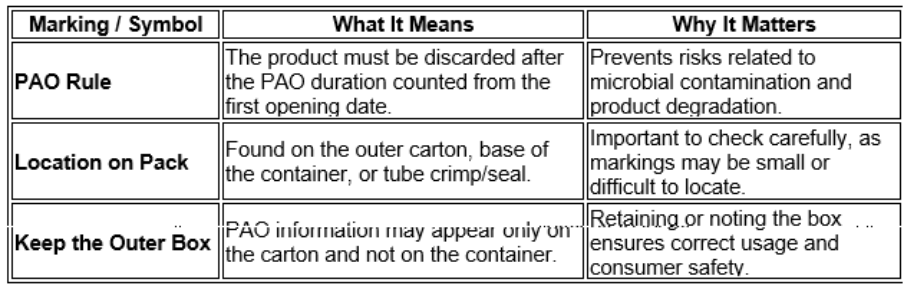
Period After Opening (PAO)
Once a product is opened, its safety depends on time after first use.
The PAO symbol (e.g., 6M, 12M, 24M) indicates how long the product can be safely used after opening, assuming normal use and storage.
PAO is especially important for creams, lotions, and serums that are frequently opened and exposed.

In Conclusion,


Written by Zymist: Shivangi Visavadiya & Edited by Zymist: Priyal Shah